Chakra Healing Sound Bath: Ultimate Guide to Vibrational Therapy
Complete, science-backed guide to chakra sound healing and practical steps for beginners
A chakra healing sound bath uses specific vibrations to balance the body’s chakras and calm the nervous system. This practice employs instruments tuned to frequencies linked with each chakra, promoting relaxation and emotional release.
Many seek sound baths to ease stress and restore energy balance but find explanations incomplete or confusing. Popular guides often mix ancient chakra concepts with modern sound healing without clarifying the differences or scientific context.
Claims about precise frequencies ‘healing’ chakras abound, yet traditions vary and scientific evidence is limited. Beginners lack clear, safe instructions for starting sound bath practice.
This guide clarifies how sound baths interact with chakras and the nervous system, explains the relevant sounds and instruments, separates tradition from modern practice, and offers practical steps with safety advice.
Recommended Tibetan Singing Bowl Set
A handmade bowl with a cushion and mallet for a simple, repeatable sound practice. Links go to Amazon and earn this site a small commission at no extra cost to you.
Premium Tibetan Singing Bowl Set
The 4-inch handmade bowl comes with a silk cushion and leather-covered mallet, so a beginner has the basic pieces for a short seated or resting session. It suits someone who wants one repeatable tone for meditation, rather than a collection of instruments.
Skip it if: Skip it if you need several pitches or a larger bowl for leading group sessions.
Chakra Healing Sound Bath: How It Balances Chakras and The Nervous System
A chakra healing sound bath uses instruments such as singing bowls, gongs and tuning forks to create sustained tones around a resting person. These tones correspond to the seven chakras, which are subtle centres arranged from the base of the spine to the crown in yogic tradition. The sound bath supports relaxation by encouraging slow, focused listening, which can calm the nervous system but does not physically alter chakras.
Chakras are not physical organs but part of a subtle-body system described in tantric and yogic texts. Modern sound healing maps specific tones and colours onto these chakras as a meditation aid. This mapping, including the rainbow colours commonly seen, is a recent development rather than a classical rule; our guide to colour therapy for chakras explains this history.
The seven chakras from Muladhara (root) at the base to Sahasrara (crown) above the head, as used in modern sound healing practice.
During a session, lower-pitched sounds are played near the lower body and higher-pitched near the head, reflecting the root-to-crown chakra order. These placements are symbolic and experiential, not based on measurable anatomical frequencies. The listener pays attention to sound, vibration and bodily sensations such as warmth or tingling.
Practitioners describe a mechanism called brainwave entrainment, where the brain synchronises to the rhythm of repeated tones, potentially shifting into deep rest states associated with the parasympathetic nervous system. This parasympathetic activation slows stress responses and eases breathing, contributing to a calming effect on the nervous system.
- Common sensations include warmth, heaviness, drowsiness or altered time perception.
- Some people report emotional release, memories or visual imagery during quiet focus; these do not prove any chakra blockage has been cleared.
- Sessions typically last 45 to 90 minutes in groups; individual sessions vary. Duration does not determine therapeutic effect.
Precise expectations
A sound bath creates a calming environment and supports reflection but does not replace medical or psychological treatment. Loud instruments may worsen tinnitus or sound sensitivity.
Specific Sounds and Frequencies for Each Chakra
The sounds most often assigned to the seven chakras are the bija mantras, or seed syllables, alongside a modern list of Solfeggio frequencies. There is no single fixed frequency for each chakra: the syllable pairings come from chakra traditions, while the numerical pairings vary in modern sound-healing practice.
| Chakra | Bija mantra | Common modern frequency |
|---|---|---|
| Muladhara (root) | Lam | 396 Hz |
| Svadhisthana (sacral) | Vam | 417 Hz |
| Manipura (solar plexus) | Ram | 528 Hz |
| Anahata (heart) | Yam | 639 Hz |
| Vishuddha (throat) | Ham | 741 Hz |
| Ajna (third eye) | Om or Aum | 852 Hz |
| Sahasrara (crown) | Om, Aum or silence | 963 Hz |
Bija mantras reflect commonly taught chakra practice. The Solfeggio column shows a widespread modern pairing, not a documented universal standard.
A bija mantra is voiced with a sustained vowel and a closing nasal sound: Lam becomes a long “laaam”, for example. Teachers may use vowel sounds, spoken chants or silence instead. The exact Sanskrit spelling, pronunciation and crown-chakra assignment differ between lineages, so treat the table as a working map rather than a historical consensus.
Singing bowls and gongs produce complex tones with a fundamental pitch and overtones, not one perfectly isolated frequency. A tuning fork gives a more focused tone, while the voice lets you alter pitch, volume and resonance directly. For that reason, a practitioner may choose a tone that feels comfortable and easy to sustain rather than force a numerical match.
Personal resonance
Use the frequency list as a prompt for attention, not as a prescription. If a tone feels harsh, lowers your breathing comfort or increases tension, change the instrument, reduce the volume or stop. Claims that Solfeggio tones repair DNA or create miraculous results have no scientific verification.
Step-by-Step Guide to Performing a Chakra Sound Healing Session
Start chakra sound healing with a single instrument, low volume and a brief session. Lie on a mat or sit with support; keep water nearby. Stop if you feel pain, dizziness or distress.
- Prepare your spaceSelect a quiet room and dim the lights. Turn off phones and notifications. Lie down with a folded blanket under your knees to ease lower back tension.
- Select your soundChoose one singing bowl or a gentle recording tuned to chakra frequencies. Begin softly; the sound should soothe without causing ringing or discomfort.
- Settle your breathTake five slow breaths through your nose. Allow the exhalation to naturally extend longer than the inhalation, without forcing either.
- Sound from root to crownPlay or focus the sound starting at Muladhara, the root chakra, then move systematically upward through Svadhisthana, Manipura, Anahata, Vishuddha, Ajna and Sahasrara. Spend a few minutes on each or use one continuous tone while shifting your attention to each chakra in turn.
- Close and groundLet the sound fade completely before moving. Feel your body’s contact with the floor, gently roll onto one side, then sit up slowly. Drink water to rehydrate.
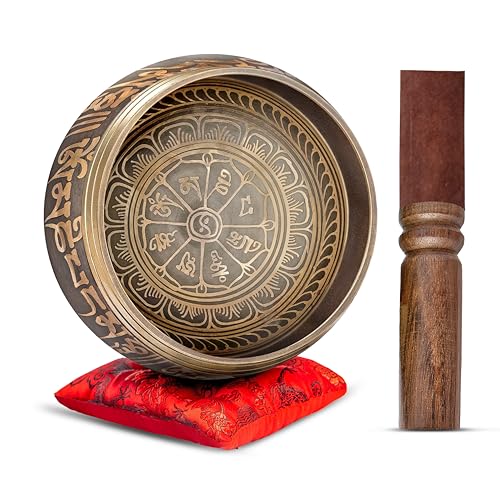
This set contains a 4-inch handmade singing bowl, silk cushion and leather-covered mallet, providing a beginner the tools for a controlled, single-tone session.
See it on Amazon →For your first session, allow 10 to 20 minutes. Longer baths, from 45 to 90 minutes, are common but do not guarantee stronger chakra effects. Recordings can substitute for live play if steady control is difficult. Keep volume moderate and avoid headphone use at high levels.
Common mistakes
Avoid striking the bowl near your ears or forcing breath retention. Do not interpret tingling, visions or emotional responses as proof of chakra shifts. Never practice while driving. Consult a qualified professional if sound, lying down or breathwork worsen a health condition.
Scientific Evidence and Limits of Chakra Sound Healing Claims
Scientific studies supporting chakra sound healing are limited. Research and clinical discussion around music and sound suggest that steady, pleasant tones can support relaxation, while claims that a particular frequency repairs a chakra remain unverified.
Some sound-healing accounts describe brainwave entrainment, in which an external rhythm is said to guide brain activity towards theta or delta states. This mechanism is plausible as a hypothesis, but the available claims do not establish that singing bowls or Solfeggio frequencies reliably produce those states, still less that they heal a named chakra.
Relaxation may involve the parasympathetic nervous system, which helps regulate rest after stress. Slower breathing, quiet surroundings and sustained music can all contribute to that response. A calmer pulse or reduced tension does not identify a chakra effect; it shows that the session may have helped someone settle.
Solfeggio claims
The popular claim that 396 Hz, 528 Hz or other Solfeggio frequencies repair DNA or cause miracles has no scientific verification. These pairings belong to modern sound-healing practice, and different systems assign different tones.
Sound baths may promote relaxation and a sense of emotional release. There is no good evidence that they cure physical or psychological conditions, remove medical blockages or heal chakras as measurable structures.
How Different Sound Healing Instruments Affect Chakra Activation
To choose instruments for chakra activation, start with the sound you can play comfortably and repeat. No chakra has one fixed tone: traditional seed syllables and modern frequency pairings vary, so treat a sound as a practice cue rather than a guaranteed mechanism.
Singing bowls
A bowl produces a sustained, resonant tone that is easy to maintain while lying down. Practitioners often pair bowls with the lower chakras, including Muladhara (the root chakra), or choose a bowl whose pitch feels steady and pleasant. Bowls are less portable than forks but remain simple for home use.
Gongs
A gong creates a broad wash of changing overtones. It suits a group sound bath or the opening and closing of a session, when a gradual rise and fall in volume is useful. Its size and volume make it a poor first choice for a small, quiet room.
Tuning forks
A tuning fork gives a clear, brief tone and is the easiest option to carry. A practitioner may select a tone linked in modern charts with Vishuddha (the throat chakra), Ajna (the third eye chakra) or another centre, while recognising that those links are contemporary assignments.
Bells
Bells make a bright attack followed by a short decay. Use one to mark a transition, bring attention back to the room or accompany a seed syllable. It offers less sustained sound than a bowl and usually suits brief cues rather than a full session.
Test one instrument at a low volume for several minutes. Notice whether its pitch, decay and physical feel help you stay attentive; personal preference matters more than matching a chart exactly. Add another instrument only after you can control the first one.
Integrating Chakra Sound Baths Into Daily Practice Safely
To safely integrate sound baths into daily practice, begin with 5–10 minutes two or three times a week, then increase only if your body remains settled. The main risks or contraindications are excessive volume, sound sensitivity and unwanted physical or emotional reactions, rather than a blocked chakra requiring stronger sound.
Sit or lie in a quiet room, keep the instrument at a comfortable distance and leave yourself an easy way to stop. Tingling, tears, vivid images or a changed sense of time can occur during a session, but they are not proof of chakra movement. Stop if you notice pain, dizziness, panic, headache, ringing in the ears or agitation. Let hearing and breathing return to normal before trying again.
Protect your hearing
Do not strike a gong or bowl close to your ears, and do not raise the volume to chase a sensation. People with tinnitus, sound-triggered migraine, epilepsy or another condition affected by sound should ask a qualified health professional before practising.
Crystals and aromatherapy can serve as optional sensory anchors. Place a crystal beside the mat rather than claiming it changes the tone, and use only a familiar, diluted oil with good ventilation; avoid oils if you have an allergy or respiratory sensitivity. Never use these additions as substitutes for medical or psychological care.
Suits
- Short, repeatable sessions that fit a daily routine
- One quiet instrument and a volume you can control
- Adjusting the tone, duration or silence to your response
Less suited to
- Long sessions that leave you wired or fatigued
- Loud group gongs in a small room
- Continuing through pain, ringing or distress
Commonly Claimed vs Actually About Chakra Sound Healing
| Commonly claimed | Actually |
|---|---|
| Solfeggio frequencies can repair DNA or produce miraculous results. | These claims are popular belief without scientific verification. The frequencies spread through modern sound-healing writing, where numerical pairings are often presented with more certainty than the evidence allows. |
| Sound baths cure physical or psychological conditions. | There is no scientific evidence that sound healing cures medical conditions. People may use a session for relaxation or report emotional release, but those experiences do not replace assessment or treatment. |
| Each chakra has one fixed frequency that must be used. | Different traditions assign different seed syllables, vowel sounds and tones. The modern Solfeggio pairings are one contemporary system, so no single frequency has authority across all chakra practices. |
| Sound waves automatically entrain the brain into theta or delta states. | Brainwave entrainment is a popular explanation, not an established result of every sound bath. A sustained tone may help some listeners settle, while the response also depends on volume, attention and personal preference. |
| The seven chakras are physical organs along the spine. | In yogic and tantric traditions, chakras describe the subtle body rather than anatomical organs. The familiar seven-centre chart is influential, but classical sources describe more than one chakra system. |
Frequently Asked Questions
Related Reading
- sound healing for chakras — Explains chakra sound practices and their modern context.
- chakra sound bath guide — Covers session structure, instruments and preparation.
- healing music for chakras — Looks at recorded music and sound-therapy routines.
- crystal harp for chakra healing — Examines the crystal harp as a sound-healing instrument.
Sources
- Sound Bath: Complete Guide to Sound Healing & Vibrational Therapy – Nicole’s ritual universe — Common sound-bath formats, sensations and modern vibrational-therapy claims.
- Sound Bath & Chakra Activation Explained: What It Is, How It Works – Créavive — Popular explanations of relaxation, brainwave entrainment and nervous-system effects.
- Chakra Healing with Sound: A Complete Guide — Chakra seed syllables, vowel sounds and sound-healing traditions.
- Chakra Healing with Sound: Complete Guide to Energetic Balance — Chakras as a subtle-body model and differing traditional frameworks.

This article covers spiritual practice, relaxation and its evidence limits; sound baths do not diagnose or treat health conditions. As an Amazon Associate, Chakra Serenity earns from qualifying purchases. Prices and availability change, so check the listing before you buy.