Master Om Meditation: A Complete Guide to Sacred Sound Practice
A practical, historical and scientific guide to Om chanting and silent practice
Master Om meditation is a practice of chanting or silently repeating the sacred syllable Om (AUM) to calm the mind and focus awareness. It embodies the fundamental states of consciousness and is a foundational mantra in Indian spiritual traditions.
Om meditation offers a method to calm the mind, deepen focus, and connect with ancient spiritual traditions. Many sources reduce it to a simple chant, but its meaning and practice run much deeper.
Common advice skips practical details like posture, breath timing, and the pronunciation nuances that affect the experience. Scientific and historical contexts are rarely combined.
This guide explains what Om represents in key texts, how to practise it step-by-step, the physiological effects, and how to avoid common mistakes.
Support Your Om Practice
Tools that enhance focus and atmosphere during meditation Links go to Amazon and earn this site a small commission at no extra cost to you.
Premium Tibetan Singing Bowl Set
This handmade singing bowl produces soothing vibrations that help maintain focus and create a peaceful environment for Om meditation. Its size and quality suit beginners and experienced practitioners alike.
Skip it if: Skip if you prefer silent or only vocal meditation without external sound aids.
Master Om Meditation: A Complete Guide to Sacred Sound Practice
Master Om meditation is the practice of chanting or silently repeating the sacred syllable Om (AUM) to focus the mind and calm mental activity. It consists of three distinct sounds—A, U, and M—each representing a state of consciousness, followed by a silence called Turiya, which symbolises a transcendent state beyond ordinary awareness.
The syllable A is pronounced as the open vowel in “father” and corresponds to the waking state, or Jagrat. The U sound follows, pronounced like the “oo” in “boot,” representing the dream state, or Svapna. The M syllable is a humming sound with closed lips, resonating in the skull, symbolising deep sleep, or Sushupti. After the M, the silence (Turiya) is experienced as the pure consciousness beyond these states.
Seven chakras with Crown chakra highlighted, linked to Om’s transcendence
- Find a quiet placeSit comfortably with your spine straight, shoulders relaxed, and eyes closed.
- Take a few deep breathsInhale slowly through the nose and exhale fully to settle your mind.
- Begin chanting OmPronounce A-U-M clearly, stretching each syllable with attention to its sound and vibration.
- Pause in silenceAfter the M, hold the silence to experience the state of Turiya.
- Repeat for 5–10 minutesMaintain steady breath and focus throughout the practice.
Pronunciation matters
Incorrect enunciation of A, U, and M can disrupt the intended vibrational effect and reduce the meditation’s impact.
Beginners should start with five to ten minutes daily. Consistency is more important than duration. Over time, you can increase the length as comfort and focus improve. Om meditation can be practised silently, whispered, or aloud depending on preference and setting.
Master Om meditation involves chanting the three syllables A, U, M with precise pronunciation, followed by a silence representing a transcendent state. Begin with five to ten minutes daily sitting comfortably with focused breathing.
Historical and Philosophical Origins of Om Meditation
Mandukya Upanishad
This ancient text dedicates its teaching to the four states of consciousness symbolised by Om: waking (A), dreaming (U), deep sleep (M), and the transcendent state (Turiya).
The Mandukya Upanishad presents Om as the sound symbolising total reality, Brahman. Each syllable corresponds to a state of consciousness: A for waking, U for dreaming, and M for deep sleep. The silence following M points toward Turiya, the infinite, unchanging consciousness beyond these states.
Vedanta philosophy describes Om as the sonic form of Brahman, the ultimate universal principle. It is the foundation of all existence and consciousness, linking the meditator to universal reality through sound.
Patanjali’s Yoga Sutras identify Om as a direct means for self-realisation. Sutras 1.27 and 1.28 recommend using Om as a mantra to focus the mind and attain Ishvara pranidhana, or surrender to universal consciousness.
Traditionally, Om is integral to Vedic mantra recitation and Upasana (meditative worship). It serves as a foundational sound in ritual and spiritual practice, marking the beginning and end of sacred texts and ceremonies.
Om meditation’s roots lie in the Mandukya Upanishad and Vedanta, where Om represents consciousness states and universal reality. Patanjali’s Yoga Sutras endorse Om as a mantra for self-realisation, and it remains central in Vedic ritual practice.
How to Practise Om Meditation: Detailed Posture, Breath and Chanting
Begin Om meditation with a stable posture that supports a straight spine. Sit cross-legged on a firm cushion or chair with feet flat and knees lower than hips. Align your head, neck and back to maintain alertness without tension.
Before chanting, take five slow abdominal breaths to settle the mind. Inhale gently through the nose, expanding the belly, then exhale fully, contracting it. This pranayama calms the nervous system and prepares the body for sound.
Chant Om as three syllables: A, U, M. Pronounce A starting low in the abdomen, U moving the sound forward through the chest, and M closing with lips gently sealed to create a humming vibration in the head. Each syllable should flow smoothly into the next without pause.
Allow the vibrations from A to be felt in the belly, U in the chest, and M in the skull. The final M should fade into silence, reflecting the fourth state, Turiya. This physical awareness anchors your focus and connects sound to body.
- Prepare your postureSit with a straight spine on a firm cushion or chair.
- Settle your breathTake five slow, deep abdominal breaths.
- Chant Om aloudPronounce A-U-M smoothly, feeling vibrations in abdomen, chest, and head.
- Use mala beads if desiredCount 108 repetitions to maintain focus.
- End with silenceAllow the M vibration to fade into quiet.
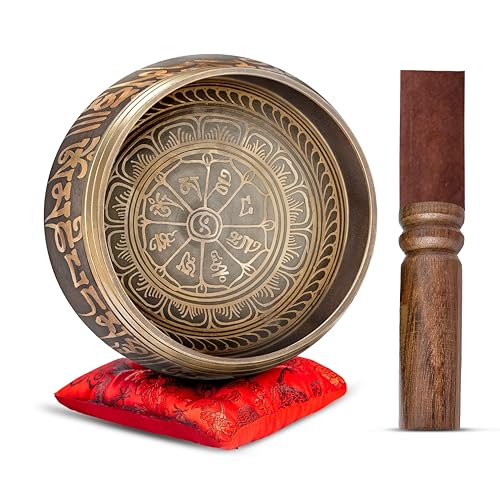
A Tibetan singing bowl can create a calming sound environment to enhance concentration during chanting.
See it on Amazon →Using mala beads is traditional to count 108 repetitions, which helps keep attention steady and marks session progress. Beginners can start with 27 or 54 counts and build up over weeks.
For stress relief, practise Om meditation for 5 to 10 minutes daily. Advanced practitioners may extend sessions to 20 or 30 minutes. Consistency matters more than length; short, regular practice yields better results.
Avoid common mistakes
Do not strain your voice or rush the syllables. Each part of Om needs space to resonate fully. Slouching collapses breath flow and dulls vibrations, reducing the practice’s calming effect.
Scientific Insights on Om Chanting and Its Effects on the Nervous System
Chanting Om stimulates the vagus nerve, which activates the parasympathetic nervous system responsible for relaxation and recovery. This reduces heart rate and lowers blood pressure, promoting calmness.
Functional MRI studies show that Om chanting decreases activity in the amygdala, the brain’s centre for fear and anxiety. This neurological change correlates with reduced stress and improved emotional regulation.
Electroencephalogram (EEG) recordings during Om meditation reveal an increase in alpha and theta brain waves. These frequencies are linked to restful alertness, creativity and a quiet mind.
Om chanting synchronises breathing and heartbeat, creating heart-brain coherence. This physiological alignment supports mental clarity and emotional balance during meditation.
Silence matters
The silent pause after chanting Om activates brain regions associated with introspection and deep rest. This silence is not empty but a crucial neurological phase that consolidates the calming effects.
These findings explain why Om meditation is effective for stress relief and mental focus. Scientific evidence supports traditional claims that this practice impacts both the body and brain through measurable physiological pathways.
Beginners can benefit from understanding these mechanisms, as it encourages patience and confidence in the gradual effects of regular Om meditation.
For further exploration of sound and vibration in meditation, see Ayurvedic Sound Healing: Ancient Vibrations for Modern Wellness.
Common Challenges and Mistakes in Om Meditation and Their Solutions
A frequent mistake in Om meditation is difficulty focusing, often caused by the wandering mind. When this happens, gently bring attention back to the sound or silent repetition of Om without judgement. Using mala beads for counting repetitions can support concentration.
Physical Discomfort
Sitting with a straight spine is crucial, but beginners often experience discomfort. Adjust by sitting on a firm cushion or folded blanket to raise the hips above the knees, reducing strain. Avoid slouching or forcing posture, which causes tension.
Many feel self-conscious chanting Om aloud, especially in public or group settings. Whispering or silent repetition are valid alternatives. Chanting aloud can enhance vibration awareness but should be comfortable.
- Balance Silent and Aloud ChantingStart silently to build inner focus. Gradually introduce whispered or soft aloud chanting once comfortable.
- Correct PronunciationPronounce Om as three parts: ‘A’ open and deep, ‘U’ rolling forward, ‘M’ closed and humming. Avoid rushing; each part should flow smoothly.
Rushed or Incorrect Pronunciation
Skipping the ‘U’ or clipping the syllables reduces the mantra’s intended effect. Take time with each syllable to support the subtle vibration and mental focus.
Integrating Om Meditation Into Your Daily Life
Om meditation extends beyond formal sessions. Silently repeating Om during stressful moments can quickly calm the mind. This practice helps anchor awareness and reduce tension without needing time apart.
Many combine Om chanting with yoga or breathwork. Chanting Om during exhalation supports synchronising breath and sound, deepening relaxation and focus.
Listening to recorded Om chants offers another way to experience the sound’s calming effects. Choose recordings with clear, steady chanting and use them during breaks or before sleep.
Using Om as a mantra throughout the day—such as during walking or waiting—can maintain mental clarity. Short two-minute sessions, as many beginners prefer, fit easily into daily routines and provide regular resets for attention.
Integrate Om silently in moments of stress and with breathwork or yoga for enhanced benefit. Recorded chants support practice, and brief sessions throughout the day build consistency and calm.
Commonly Claimed vs Actually About Om Meditation
| Commonly claimed | Actually |
|---|---|
| Om is just a mystical sound used to raise vibrations | Om represents total reality (Brahman) as explained in the Mandukya Upanishad, not merely a mystical sound. |
| Chanting Om instantly cures stress and mental disorders | While Om chanting may promote relaxation, scientific evidence is limited and it is not a medical treatment. |
| Om meditation is only for advanced yogis | Om meditation is accessible to beginners and recommended as a foundational practice in many traditions. |
| The silence after chanting Om is optional | The silence after Om represents Turiya, the transcendent fourth state of consciousness, and is integral to the practice. |
| Om chanting always produces the same vibration for everyone | Individual vocal tone and technique affect vibrations; the ‘M’ syllable aims to resonate in the skull but varies by practitioner. |
Frequently Asked Questions
Related Reading
- Chakra Sound Meditation — Harmonise energy centres with sound
- Powerful Sacred Symbols — Explore symbols used in meditation
- Powerful Crystal Meditation Practices — Use crystals to support focus
- Best Headphones for Meditation — Choose headphones suited for meditation
Sources
- Sacred OM (AUM) Meditation — Guided Meditation | InnerVeda — Mandukya Upanishad, practice details, Yoga Sutras references
- Om meditation | A step-by-step guide to practice – AYM Goa — Scientific effects on nervous system, common mistakes
- Om Mantra: Complete Guide — Meaning, Practice, and Power of the Sacred Sound | Vishva Vidya | Vishva Vidya — Philosophical origins, syllable meanings, tradition
- What is Om meditation? Plus, a step-by-step guide to practice — Calm Blog — Pronunciation guidance, modern practice details
- Wikipedia — General background and verification

The article covers historical, practical, and scientific aspects of Om meditation without addressing medical treatment; consult a qualified professional for health issues. As an Amazon Associate, Chakra Serenity earns from qualifying purchases. Prices and availability change, so check the listing before you buy.