Sound Healing for Chakras: A Complete Guide to Vibrational Balance
A clear, practical guide to chakra sound healing and its methods beyond common misconceptions
Sound healing for chakras uses specific vibrations and frequencies to resonate with each energy centre, promoting balance and relaxation. This practice involves vocal tones, instruments like singing bowls, and frequency-based methods to clear blockages and support wellbeing. It combines traditional chakra knowledge and modern sound therapy techniques.
Many seek sound healing to balance chakras but find conflicting information on frequencies, tools, and effects. Some sources claim exact Solfeggio frequency matches or guaranteed cures, which lack historical or scientific support.
Traditional and modern chakra sound systems differ, and readers often want clear instructions on how to practise effectively and safely.
This guide clarifies these points, explaining chakra sound healing’s roots and methods, distinguishing fact from belief, and offering a step-by-step routine for beginners and advanced users.
Sound Tools for Chakra Healing
Choose instruments that create clear, resonant tones for your practice. Links go to Amazon and earn this site a small commission at no extra cost to you.
Tibetan Singing Bowl Set
This set includes a four-inch handmade bowl, a silk cushion and a black leather-covered mallet, so a beginner has the basic pieces for a seated sound practice. It suits meditation, yoga and relaxation where a single bowl is easier to use consistently than several instruments.
Skip it if: Skip it if you need a very quiet practice or want a tool with a fixed measured frequency.
Sound Healing for Chakras: How It Works and Why It Matters
Sound healing for chakras is a contemplative practice that uses vocal tones, instruments or recorded sounds while focusing on the body’s chakra map. It may support relaxation and attention, but chakra balancing cannot cure a physical or psychological condition, and there is no scientific proof that sound removes a medical chakra blockage.
To practise how to balance chakras, a person usually places attention on one centre, produces or listens to a steady sound, and notices the breath and bodily sensations. Resonance describes the way a sound can reinforce vibration in a material or space; in chakra work, practitioners extend that idea to subtle energy centres. The chakra is a traditional model, not a physical organ that can be measured like the heart or liver.
The seven-chakra model from Muladhara at the base to Sahasrara at the crown. This familiar arrangement is a traditional and modern teaching map, not an anatomical diagram.
The seven-centre chart is widely used today, with Muladhara, the root chakra, at the base and Sahasrara, the crown chakra, at the top. Classical Indian sources describe more than one chakra system, with different numbers, locations and attributes. The rainbow colours often printed beside the centres belong mainly to modern Western presentations.
Traditional Sounds And Modern Frequency Pairings
Tantric and yoga-based teachings use seed syllables and vowel sounds for mantra or toning practice. These systems vary, so no single ancient chart assigns one fixed tone to every chakra. Solfeggio frequencies, such as 396 Hz or 528 Hz, are modern additions commonly paired with chakras in contemporary sound-healing music; the exact pairings have no established classical textual basis.
The practical mechanism is simpler than many claims suggest. A sustained tone gives the mind one object, slows attention towards the breath and may create a pleasant sensation of resonance in the chest, throat or face. Singing bowls, humming and gentle recorded music can therefore become relaxation practices. Practitioners may describe emotional release or clearer focus, but those reports do not show that a chakra has been physically opened or cleared.
What Research Supports
Sound and music can influence the nervous system and promote relaxation. That finding does not validate a specific chakra location, frequency pairing or claim that sound treats illness.
Keep The Boundary Clear
Use chakra sound work for reflection, meditation or relaxation. Seek a qualified healthcare professional for pain, anxiety, depression, hearing problems or any other medical concern.
A short humming practice can be a sensible starting point. For a more detailed chakra sequence, see this step-by-step guide to balancing all seven chakras.
Frequencies and Sounds for Each Chakra
Chakra colours, chakra stones and chakra balancing music belong to the modern teaching landscape, not one fixed Sanskrit system. People also use bowls, chants and recorded tones for chakra cleansing and chakra balancing; these terms describe a ritual or meditative intention, not a medically verified process.
The table below separates a commonly used modern vowel-toning sequence from traditional chakra meanings. The vowel sounds are approximate vocal shapes rather than universal ancient assignments. Solfeggio pairings are also contemporary popular practice, so treat the numbers as options for listening, not exact prescriptions.
| Chakra | Vowel tone | Traditional association | Common modern pairing |
|---|---|---|---|
| Muladhara, root | UH, as in cup | Grounding and safety | 396 Hz |
| Svadhishthana, sacral | OO, as in moon | Creativity and emotional expression | 417 Hz |
| Manipura, solar plexus | OH, as in open | Personal power and confidence | 528 Hz |
| Anahata, heart | AH, as in father | Love, compassion and connection | 639 Hz |
| Vishuddha, throat | EYE, as in eye | Speech and expression | 741 Hz |
| Ajna, third eye | AY, as in day | Insight and attention | 852 Hz |
| Sahasrara, crown | EE, as in see, or silence | Contemplation and spiritual awareness | 963 Hz |
Vowel shapes, meanings and Solfeggio pairings vary between modern teachers; none is a universal classical standard.
Matching Instruments To The Practice
A singing bowl suits a slow session centred on one chakra because its struck or rubbed tone can continue while you breathe. A drum gives the root and sacral practices a clear pulse. A tuning fork offers a precise, sustained pitch for listeners who prefer a single tone. Gongs and other resonant instruments create a broad sound field, so keep them gentle and leave space between strikes.
One practical combination is a low bowl tone with the UH vowel for Muladhara, followed by a softer OO chant for Svadhishthana. A middle-register hum with AH can accompany Anahata, while an EYE tone and a quiet tuning fork can focus attention at Vishuddha. These combinations express current practice choices; they do not prove that a particular sound acts on a particular organ or gland.
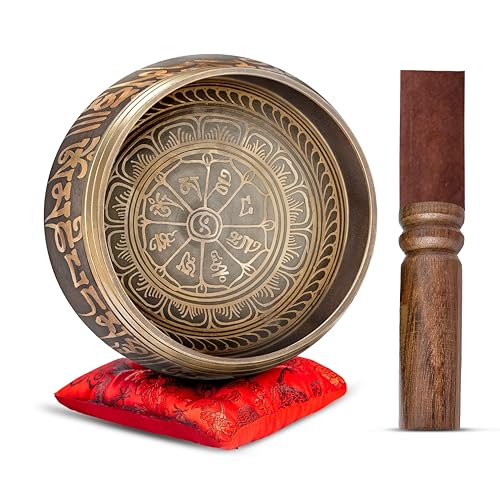
This set includes a 4-inch handmade singing bowl, a silk cushion and a leather-covered mallet, giving a beginner the basic pieces for a steady struck tone during chakra meditation.
See it on Amazon →Place the bowl on its cushion rather than directly on a hard floor, strike it lightly and let the sound fade before repeating. If you prefer vocal work, begin with one vowel on a comfortable pitch and let the breath end naturally. A chakra frequency healing guide can help you compare listening-based approaches without treating the listed frequencies as ancient facts.
Frequency Claims
No Solfeggio number is scientifically established as the correct frequency for a chakra. Stop or reduce the volume if sound causes pain, dizziness or distress, and take extra care with tinnitus or hearing sensitivity.
Step-by-Step Sound Healing Routine for Chakras
Sound healing for chakras involves a deliberate sequence of tones from the root to the crown chakra, followed by a period of silence. This method, common in contemporary practice, offers a clear structure for focusing attention on each chakra rather than a literal physical clearing.
Prepare a 27-Minute Session
- Sit with knees lower than hips using a firm cushion or folded blanket to keep your spine straight and your jaw relaxed.
- Breathe quietly for three minutes, inhaling through your nose at a comfortable pace and exhaling slightly longer. Feel the weight of your body on the floor.
- Starting at Muladhara (root chakra), move upward to Sahasrara (crown chakra), spending three minutes on each chakra while producing a low, comfortable tone on each exhale.
- Use these seed syllables on the exhale for each chakra: Muladhara – LAM; Svadhishthana (sacral) – VAM; Manipura (solar plexus) – RAM; Anahata (heart) – YAM; Vishuddha (throat) – HAM; Ajna (third eye) – OM; then remain silent with focused attention on Sahasrara. Pronounce syllables slowly, stopping if your throat feels strained.
- If using a singing bowl, strike it once at the start of each three-minute chakra interval and let the sound fade before vocal toning. Place the bowl on its cushion rather than on your body to preserve sound quality.
- End with three minutes of silence. Notice your breath, contact with your seat, and any shift in awareness before finishing the session.
The 4-inch singing bowl, cushion and leather-covered mallet provide a compact, clear signal to open and close each chakra interval. Vocal toning offers quieter control if volume or pitch precision is important to you.
See it on Amazon →The seed syllable sequence is a modern convention, not fixed in classical texts. Treat these sounds as cues for attention. Lower tones may suit the root and sacral chakras, while softer higher tones fit the upper chakras. Comfort and ease in producing the sounds take priority over matching exact frequencies.
Modify the Practice for Greater Focus
After establishing the basic rhythm for a week, extend each chakra’s toning time to five minutes. Focus additional time only on chakras that draw your attention. Always start at the root and end at the crown to maintain a coherent beginning and conclusion. Consider adding gentle movement or journalling, or attending guided sound baths, but adjust one element at a time to identify what influences your focus.
Maintain Comfort and Safety
Avoid placing loud instruments like bowls or tuning forks close to your ears. If you experience discomfort, distress or physical symptoms, reduce volume or stop. Seek advice from qualified medical or psychological professionals for health concerns rather than attributing them to chakra blockages.
Comparing Traditional Chakra Sounds and Solfeggio Frequencies
Sound healing for chakras uses two main sound systems: traditional seed syllables and modern Solfeggio frequencies. These come from different origins and serve distinct purposes. They are often combined in practice but should be understood separately.
Traditional Seed Syllables (Bija Mantras)
In tantric chakra teachings, each chakra centre corresponds to a seed syllable called a bija mantra. The most common sequence is LAM for the root (Muladhara), VAM for the sacral (Svadhishthana), RAM for the solar plexus (Manipura), YAM for the heart (Anahata), HAM for the throat (Vishuddha), OM for the third eye (Ajna), and silence or meditation for the crown (Sahasrara). Each syllable is pronounced on a long, steady exhale, letting the final nasal sound fade naturally. This sequence is a widely taught practice convention, not a fixed classical Sanskrit chart, as older texts show variations.
Some practitioners use sustained vowel sounds instead of or alongside the bija mantras. These vowels provide a simple tonal focus for vocal practice but do not represent a historically established vowel-to-chakra mapping.
Modern Solfeggio Frequencies
Solfeggio frequencies are a set of specific tones popularised in contemporary sound healing. Commonly, seven frequencies from 396 Hz to 963 Hz are paired with the seven chakras as shown in modern Western wellness charts. These pairings are recent inventions and are not found in classical Indian chakra literature. Sound healing tracks, tuning forks, or instruments supply these tones instead of the voice.
Historical Accuracy
No classical or tantric chakra text links the Solfeggio frequencies to the chakra system. This pairing is a modern wellness practice, not an ancient tradition.
Practitioners may chant seed syllables while listening to a Solfeggio tone or use one system exclusively during a session. Seed syllables engage breath and vocalisation, encouraging active participation. Solfeggio tones provide a precise listening focus. Neither system has scientific evidence to treat medical or psychological conditions.
Scientific Evidence and Limitations of Chakra Sound Healing
Scientific validation for chakra sound healing is limited. Research supports a narrower claim: sound and music can influence the nervous system and promote relaxation. That finding applies to sound-based practices generally; it does not confirm that a tone corresponds to a particular chakra or that it clears a blockage.
A singing bowl, voice or gong may draw attention to breathing and reduce competing sensory input. A steady tone can give the mind one object to follow, while slower breathing and a quiet setting may support a calmer state. Practitioners often describe this as releasing an emotional block. That report can be meaningful, but it does not show that sound has repaired a physical organ or changed a chakra as a measurable structure.
Brainwave Entrainment And Binaural Beats
Binaural beats use two slightly different tones, one presented to each ear. The listener perceives a rhythmic beat based on the difference between them. Some recordings claim that this beat entrains brainwaves linked with relaxation or concentration. Evidence remains mixed, and the proposed effect is not specific to chakra balancing or activation. A binaural track should therefore be treated as an aid to focused listening, not as a proven chakra treatment.
What the evidence supports
Sound may help relaxation, attention and the felt experience of a meditation session. There is no established Solfeggio frequency that scientifically targets Muladhara, Anahata or another chakra.
Expectation also matters. The meaning attached to a ritual, the practitioner’s attention, and the sense of taking time for oneself may shape what the session feels like. These psychological effects can explain part of a reported benefit without making the experience false; they do, however, make claims of a unique frequency mechanism harder to justify.
Health claims
Sound cannot be shown to cure physical or psychological conditions, and it cannot be relied on to unblock physical chakra issues. For pain, persistent distress, hearing problems or any other health concern, consult a qualified health professional rather than replacing care with chakra sound healing.
Choosing Instruments and Sounds for Your Practice
For the best instruments for chakra sound healing, start with the one you can use steadily and hear comfortably. Singing bowls suit a seated practice; tuning forks produce a clear single tone; gongs create a broad, sustained wash; and drums provide a grounded pulse. None has a documented exclusive link to one chakra.
Choose tone by its practical effect rather than by an exact chakra claim. A low, gentle bowl tone may support a slower session focused on Muladhara, while a bright vocal tone may hold attention near Vishuddha, the throat chakra. These are practice choices. The modern pairing of instruments or frequencies with chakra colours and locations is not a fixed teaching found across classical sources.
Quality, Size And Material
A bowl should ring cleanly without a harsh buzz, and its cushion should keep it stable. A smaller bowl is easier to place beside a meditation seat; a larger gong needs more space and can overwhelm a quiet room. With tuning forks, check that the tone is comfortable and that the handle is easy to hold. Material affects tone and durability, but it does not prove a spiritual result.
- Choose one sound sourceUse a bowl, fork, gong or drum that you can hear without strain.
- Set a safe distanceKeep loud instruments away from the ears; stop if you feel pain, dizziness or ringing.
- Add breathworkMake the exhale slightly longer than the inhale, without forcing the breath.
- Use a crystal by preferencePlace a chakra stone nearby as a focus object, not as a required part of the sound.
Product 1 includes a 4-inch handmade bowl, cushion and mallet, so a beginner can make one controlled tone without assembling separate pieces.
See it on Amazon →A chakra wand or chakra stones can support visual focus during the session, but modern crystal pairings are a separate tradition from the instrument’s acoustic function. Keep stones and wands off the bowl’s rim, store them dry, and wipe the bowl and mallet with a soft cloth. Never strike near another person’s ear, and use a lower volume for children, pets or anyone sensitive to sound.
Common Claims vs Actual Facts About Chakra Sound Healing
| Commonly claimed | Actually |
|---|---|
| Each chakra has one exact Solfeggio frequency. | The familiar chakra-to-Solfeggio pairings are a modern popular belief. Classical chakra texts do not provide one universal frequency chart, so different practitioners use different pairings. |
| Sound healing can cure physical or psychological conditions. | There is no scientific evidence that chakra sound healing cures medical or psychological conditions. Sound may support relaxation, and practitioners report emotional benefits, but those reports are not a substitute for clinical care. |
| The chakra system has always contained seven centres with fixed colours. | Classical sources describe different numbers of chakras and varying attributes. The seven-centre rainbow chart became widespread through modern Western teaching. |
| All chakra traditions use the same vowel sounds. | Several modern and traditional practices use vowel or seed sounds, but there is no single universally accepted system. Pronunciation, sequence and chakra associations vary between lineages. |
| A louder bowl or gong produces better chakra results. | Volume does not establish a chakra effect. A comfortable tone supports steady attention; a sound that feels harsh or causes discomfort is a poor choice for practice. |
Frequently Asked Questions
Related Reading
- a simple guide to chakra healing — Explains the wider chakra-healing framework beyond sound.
- seven steps to balance your chakras — Offers a short daily sequence for chakra-focused practice.
- the basics of chakra healing — Defines chakra healing and its modern practice context.
- a chakra healing sound bath guide — Covers sound-bath structure, instruments and session preparation.
Sources
- Chakra Healing with Sound: A Complete Guide — Modern sound-healing methods, chakra tones and Solfeggio pairings.
- Chakra Balancing with Sound: A Guide to Frequency-Based Energy Healing – Vibra-Zen — Sound practices, relaxation claims and popular frequency associations.
- Chakra Healing with Sound: Complete Guide to Energetic Balance — Varying chakra systems, subtle centres and vowel-sound traditions.
- Chakra Balancing with Sound Healing — Sound-healing tools, relaxation and practitioners’ reports of emotional release.

This article covers contemplative sound practice and does not present chakra work as medical treatment; consult a qualified professional for health concerns. As an Amazon Associate, Chakra Serenity earns from qualifying purchases. Prices and availability change, so check the listing before you buy.