Sound Healing for Chakra Harmony: A Complete Guide
Traditional mantras, frequencies, methods and safety for chakra sound healing
Sound healing balances chakras by using traditional bija mantras, specific sound frequencies, and vibrational instruments to restore harmony in the subtle energy centres. This practice blends documented Indian tradition with modern sound therapy methods.
Sound healing is widely used to balance chakras, but understanding its origins and methods can be confusing. Many sources mix modern beliefs with tradition, leading to unclear guidance.
Readers want a clear explanation of which sounds and mantras to use, how sound affects chakras physiologically, and how to practise safely and effectively.
This guide separates historic facts from popular belief, explains key concepts, and offers a practical routine with instruments and vocal techniques.
Recommended Sound Healing Tools
A simple instrument gives your practice a consistent starting tone without making claims about chakra-specific results. Links go to Amazon and earn this site a small commission at no extra cost to you.
Premium Tibetan Singing Bowl Set
The set includes a 4-inch handmade singing bowl, silk cushion and leather-covered mallet, so it covers the basic equipment for a seated sound practice. It suits someone who wants an instrument for meditation or yoga rather than a collection of separate tools.
Skip it if: Skip it if you need headphones, tuning forks or a compact instrument for travel.
Sound Healing for Chakra Harmony: A Complete Guide
Sound healing for chakra harmony is a contemplative practice that uses voice, mantras and instruments to focus attention on the body’s seven subtle centres. For chakra balancing, practitioners repeat a bija mantra or steady tone, listen to an instrument, and pair the sound with slow breathing; this is how they practise what they call a chakra cleanse or how to clear chakras.
The traditional explanation is based on resonance and vibration affecting the chakra system. The physiological explanation is narrower: sound can influence neural activity and brain-wave synchronisation, which may affect mood and relaxation. That evidence does not show that sound repairs a blocked chakra or treats a medical condition.
The seven main chakras from Muladhara, the root chakra, to Sahasrara, the crown chakra, with their Sanskrit names.
- Muladhara, the root chakra, is linked with grounding and basic stability.
- Svadhisthana, the sacral chakra, is linked with creativity and feeling.
- Manipura, the solar plexus chakra, is linked with will and personal direction.
- Anahata, the heart chakra, is linked with love and connection.
- Vishuddha, the throat chakra, is linked with communication.
- Ajna, the third-eye chakra, is linked with intuition and insight.
- Sahasrara, the crown chakra, is linked with unity and spiritual awareness.
A traditional vocal method uses seed sounds, or bija mantras. Practitioners commonly pair LAM with Muladhara, VAM with Svadhisthana, RAM with Manipura, YAM with Anahata, HAM with Vishuddha, OM with Ajna and AH with Sahasrara. Repeat one sound slowly on the out-breath, keeping attention on the associated area rather than forcing a sensation.
Modern frequency claims
Solfeggio pairings such as 396 Hz for the root chakra and 963 Hz for the crown chakra belong to modern popular practice. They are not documented as an ancient chakra system, and there is no scientific proof that a particular frequency acts on one chakra.
Common instruments include singing bowls, tuning forks and the human voice. A singing bowl gives a sustained tone that can anchor attention; vocal toning gives you direct control over pitch, volume and breath. For a first session, choose one sound source and stay with it instead of changing instruments every few seconds.
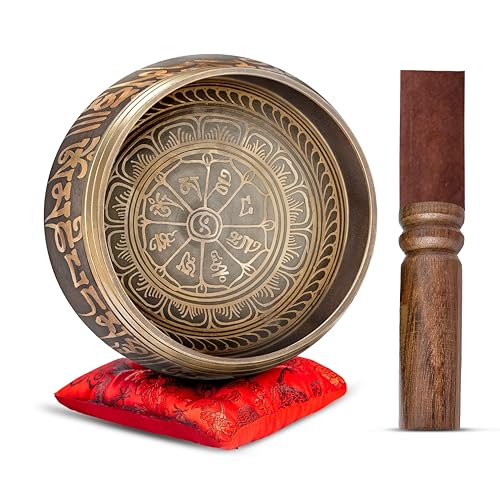
This set includes a 4-inch handmade singing bowl, a silk cushion and a leather-covered mallet, so it suits a seated practice that needs one repeatable tone. Skip it if you specifically want measured frequencies from tuning forks.
See it on Amazon →A simple approach to how to balance chakras is to sit upright, select one chakra theme, make or play a gentle sound, and observe breathing and attention for several minutes. Practitioners may describe a shift as clearing or release, but those terms describe a personal interpretation, not an anatomical change.
Historical Origins and Traditional Sound Practices
The historical origin of chakra sound healing lies in Indian Vedic and tantric traditions, where chakras were described as subtle-body centres rather than physical organs. Tantric texts developed different chakra maps and sound practices; there has never been one universal historical system matching every modern chart.
A dated source
The chakra system commonly presented today was elaborated in the 16th-century text Sat-Cakra-Nirupana, attributed to Purnananda Swami. This source matters because it gives a documented reference for a developed chakra model, rather than proving that every modern colour, crystal or frequency pairing is ancient.
Traditional bija mantras are seed syllables used within these practices. LAM, VAM, RAM, YAM, HAM, OM and AH are commonly assigned to the seven main chakras in modern teaching, while tantric texts and lineages can differ in their details. The syllable is recited as part of meditation and visualisation, not as a scientifically verified code for a bodily organ.
Nada Brahma expresses a traditional Indian idea of sound as a cosmic principle. It helps explain why sound has a central place in some spiritual disciplines, but it should not be confused with a laboratory claim about a chakra-specific frequency. Indian musical traditions also use ragas with therapeutic properties linked to health and well-being, within a musical and cultural framework distinct from a seven-chakra chart.
- Indian traditions draw on mantra, recitation, meditation and raga, with methods shaped by texts and lineages.
- Modern Western chakra practice often adds singing bowls, tuning forks, vowel toning and Solfeggio frequencies.
- The familiar seven-colour chart and one-frequency-per-chakra system are modern developments, not a single ancient Indian standard.
This distinction explains why traditional bija mantras have a stronger textual connection to chakra practice than claims that 396 Hz or 963 Hz scientifically clears a chakra. Both may appear in a contemporary sound session, but they carry different historical status.
Sound Frequencies and Their Effects on Chakras
Sounds relating to the chakras come from several systems: traditional bija mantras, Indian musical forms such as ragas, and modern frequency charts. The familiar Solfeggio frequencies chakras pairing, including 396 Hz for Muladhara (the root chakra) and 963 Hz for Sahasrara (the crown chakra), is a modern association. It does not come from a single classical Indian chakra text.
There is no scientific evidence for specific chakra frequencies. Chakras are subtle-body concepts, not anatomical structures with measurable frequencies, so researchers cannot confirm that one tone targets one centre or clears a blockage. Practitioners may find a frequency meaningful, but that personal response is different from proof of a chakra-specific effect.
| Sound approach | Common use in practice | What evidence supports |
|---|---|---|
| Sustained tone | Attention and relaxation | Sound can modulate neural activity and support brain-wave synchronisation |
| Bija mantra | Focusing on a chakra theme | Traditional use of seed sounds |
| Rhythmic drum | Alertness and grounded attention | Rhythm can affect arousal and mood |
| Soft humming | Slowing the breath and settling attention | Auditory stimulation can influence relaxation |
These effects describe sound and attention, not a proven frequency map of the chakras.
Sound healing can be stimulating or relaxing. A brisk drum pattern, bright repeated tone or vigorous chant may increase alertness. A slow bowl tone, quiet hum or sustained vowel can make it easier to settle and notice the breath. Loudness, tempo, repetition, timbre and the listener’s expectations all affect that response.
Exact frequency matching remains debated because modern charts disagree about the numbers and the chakra correspondences. A useful session therefore treats frequency as a focus for listening, rather than a prescription. Choose a sound you can hear comfortably, keep the volume moderate, and observe changes in mood, breathing and concentration.
Keep the claim precise
Traditional texts describe mantra and sound practices. Modern Solfeggio charts add numerical pairings. Neither establishes that a measured tone can medically treat a chakra or a health condition.
Practical Sound Healing Techniques for Chakras
A chakra sound healing routine starts at Muladhara, the root chakra, and moves upwards to Sahasrara, the crown chakra. Use a few minutes for each centre, keeping the timing even so one area does not dominate the session. Chakra breathing, vocal toning, a singing bowl or a gentle drum can form the main practice; oils, crystals and massage are optional modern additions.
Choose An Instrument For The Job
Singing bowls suit a sustained tone that gives the mind one sound to follow. Tuning forks produce a clear, short tone and work well when you want a precise listening point. Drums provide rhythm and are better suited to an alert, grounded opening than to a quiet closing. Start with one instrument rather than layering several sounds. A guide to chakra singing bowls can help you compare bowl types before buying.
- Prepare the spaceSit with your knees lower than your hips. Silence notifications and place your instrument within easy reach.
- Settle at the rootTake slow, unforced breaths. Sound a low bowl or drum softly, then repeat LAM aloud or silently.
- Move through the centresSpend a few minutes each on VAM, RAM, YAM, HAM, OM and AH from sacral to crown.
- Match sound to breathInhale quietly through the nose. Let the mantra, hum or instrument tone extend through the exhale.
- Listen before moving onAfter each sound, sit in silence and notice breathing, muscle tension and attention without forcing a result.
- Close graduallyLet the final tone fade. Return attention to the feet, open the eyes and drink some water if your mouth feels dry.
The seed sounds commonly used in this modern seven-centre sequence are LAM for Muladhara, VAM for Svadhisthana, RAM for Manipura, YAM for Anahata, HAM for Vishuddha, OM for Ajna and AH for Sahasrara. Pronunciation and vowel systems vary between teachers, so treat the syllable as a concentration aid rather than a fixed universal code.
Add Oils, Crystals Or Massage Carefully
To use chakra oils, place a small amount of a skin-safe prepared oil on the wrists or chest, or diffuse it according to the product instructions while you listen. Essential oils can irritate skin and airways, so patch-test topical products, avoid the eyes and never apply oil to broken skin. The chakra associations of oils and crystals belong to modern practice, not a single ancient Indian system.
Chakra massage means gentle self-massage over the area a practitioner associates with a centre, such as the lower abdomen or upper chest. It may help you notice muscle tension and breathing, but it has no established ability to move or repair a chakra. Hold a crystal nearby if its colour, weight or texture helps you maintain attention; do not place it on the throat or chest if that feels uncomfortable.
Stop if sound feels unpleasant
Keep instruments at a comfortable volume and do not place a vibrating tuning fork directly on the head, throat or chest. Stop for pain, dizziness, nausea, headache, ringing in the ears or distress. People with hearing sensitivity should use shorter sessions and seek professional advice if symptoms persist.
A steady routine beats a crowded one
Use one voice technique and one instrument for the first session. Adding every mantra, oil, crystal and instrument at once makes it difficult to tell which sound affected your attention.
Advanced Sound Healing Methods and Integration
Binaural beats chakra healing uses two slightly different tones, one sent to each ear through headphones. The brain perceives a rhythmic beat between them, and research indicates that such sound can modulate neural activity and support relaxation. The beat has no scientifically established link to a particular chakra, so treat chakra pairings as a modern practice rather than a measured effect.
Overtone singing for the chakras uses the voice to produce a fundamental note alongside audible harmonics. Singers shape the mouth and throat to bring different overtones forward, then direct attention towards a chosen subtle centre. This can sharpen listening and breath awareness. Claims that one harmonic physically opens or realigns a chakra remain traditional or modern practitioner claims, not anatomical findings.
Combine Sound With Meditation
Use sound as the object of meditation rather than adding several techniques at once. Sit for five minutes, listen to one bowl or tone, and notice its pitch, decay and effect on your breathing. Add a bija mantra such as LAM or YAM only after attention settles. This sequence makes it easier to distinguish the sound itself from the meaning you attach to a chakra.
Crystals and essential oils can serve as sensory cues in a modern chakra routine. Place one crystal beside the mat, or use a properly diluted oil only if its scent suits you; neither has a documented chakra-specific mechanism. Never ingest essential oils, apply them undiluted, or use them around someone with a known sensitivity.
Choose advanced methods when
- You already practise steady breath or mantra meditation.
- Headphones, overtone work or instruments help you maintain attention.
- You want to study one sound technique rather than collect several claims.
Use a simpler method when
- Loud tones cause ear discomfort, headache or ringing.
- Binaural beats make you feel unsettled or distract you.
- You are using sound to avoid assessment for a physical or psychological symptom.
Keep the volume low, stop if discomfort appears, and allow quiet after an intense session. People with tinnitus, sound sensitivity or a neurological condition should ask a qualified clinician before using prolonged or stimulating audio. In this context, chakra realignment means a practitioner’s description of a felt change in attention or mood, not a verified movement of a physical organ.
Common Misconceptions About Sound Healing for Chakras
Chakra sound healing can be stimulating or relaxing, depending on volume, tempo, pitch, breath pattern and the listener’s response. A low, sustained tone may settle attention, while a bright tone or vigorous vocal practice may increase alertness. That response does not prove that a chakra has opened.
| Claim | What the evidence and history support |
|---|---|
| Chakra colours | The familiar rainbow chakra colours are modern Western additions. They are widely used in contemporary teaching, but they are not a single ancient or universal Indian system. |
| Chakra stones | Crystal pairings belong mainly to modern practice. A stone may act as a tactile reminder during meditation, but no evidence shows that a gemstone changes a chakra. |
| Chakra frequencies cure blockages | Solfeggio pairings such as 396 Hz for the root and 963 Hz for the crown are modern associations. No frequency has been shown scientifically to cure a chakra blockage. |
| Chakras are organs | Chakras come from Indian Vedic and tantric subtle-body traditions. They are concepts used to describe centres along the body’s axis, not structures that can be identified in anatomy. |
Separate documented tradition from contemporary chakra teaching.
Bija mantras are traditional seed sounds. Common examples include LAM, VAM, RAM, YAM, HAM, OM and AH, but vowel-based sound sets vary between practitioners. There is no single documented vowel sequence that every chakra tradition uses, so a different set is not automatically an error.
Sound may support meditation, attention and relaxation, and practitioners report changes in mood or felt tension. It does not replace medical care. Persistent pain, hearing changes, severe distress or other symptoms need assessment from a qualified health professional rather than a frequency, crystal or mantra.
Common Misconceptions About Sound Healing for Chakras
| Commonly claimed | Actually |
|---|---|
| Each chakra has one Solfeggio frequency that scientifically clears blockages. | The familiar pairings, such as 396 Hz for Muladhara and 963 Hz for Sahasrara, are modern associations. No scientific evidence shows that these tones act on chakra-specific blockages. |
| The rainbow colours assigned to the seven chakras come from ancient Indian texts. | The rainbow sequence is a modern Western convention. Classical Indian sources describe different chakra systems and do not establish one universal colour chart. |
| Chakras are physical organs that doctors can locate in the body. | Chakras are subtle-body concepts from Indian religious and philosophical traditions. They have no direct anatomical counterpart, although practitioners use bodily locations as meditation points. |
| Any vowel sound system can be presented as the traditional chakra system. | Practitioners use several vowel sets, and no single sequence is documented as universal. Bija mantras have stronger roots in tantric practice than many modern vowel charts. |
| Sound healing can cure emotional or physical blockages. | Practitioners may report greater calm or a sense of release, but these reports do not establish a medical treatment. Sound can support attention and relaxation without proving a chakra-specific cure. |
Frequently Asked Questions
Related Reading
- sound healing for chakras — A second look at vibrational practices and chakra-focused routines.
- chakra chants and sound healing — Explains chanting methods and how practitioners use vocal sound.
- chakra healing sound baths — Covers group and home sound-bath formats with practical guidance.
- chakra tuning forks — Compares tuning-fork use with vocal and bowl-based practices.
Sources
- Chakra Healing with Sound: Complete Guide to Energetic Balance — Contemporary sound-healing practices, chakra themes and practitioner reports.
- Chakra Healing with Sound: A Complete Guide — Modern frequency pairings, vowel variations and common chakra claims.
- Sound Frequencies For Chakra Balancing – Complete Guide – Altered Mind Waves — Solfeggio associations, instruments and sound-related relaxation claims.
- Sound Healing for Each Chakra | AstraTalk Blog — Bija mantras, ragas, tantric history and the Sat-Cakra-Nirupana.
- Chakra – Wikipedia — Vedic and tantric origins and the subtle-body character of chakras.

This article covers contemplative and cultural practices, not medical treatment; consult a qualified professional for health concerns. As an Amazon Associate, Chakra Serenity earns from qualifying purchases. Prices and availability change, so check the listing before you buy.